ASPBAE Youth Corner: Harnessing Youth-Led Accountability to Transform Education
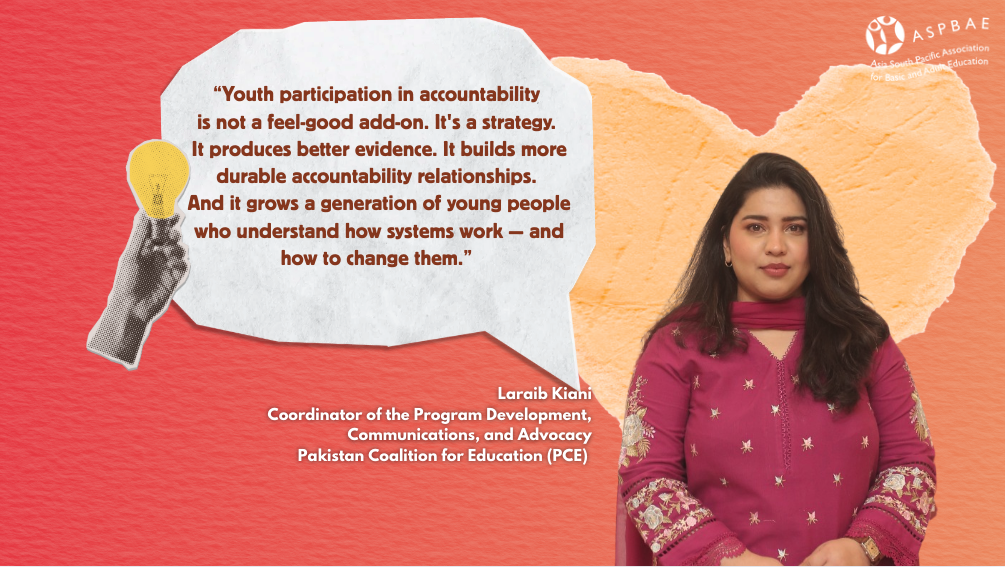
“Youth participation in accountability work is not a feel-good add-on. It’s a strategy. It produces better evidence. It builds more durable accountability relationships. And it grows a generation of young people who understand how systems work — and how to change them,” said Laraib Kiani, Pakistan Coalition for Education (PCE)’s Coordinator of the Program Development, Communications and Advocacy, during the Global Campaign for Education’s (GCE) Global Youth Exchange on “Transforming Education Outcomes Through Systems Strengthening and Social Accountability Monitoring – Global Youth Exchange.”
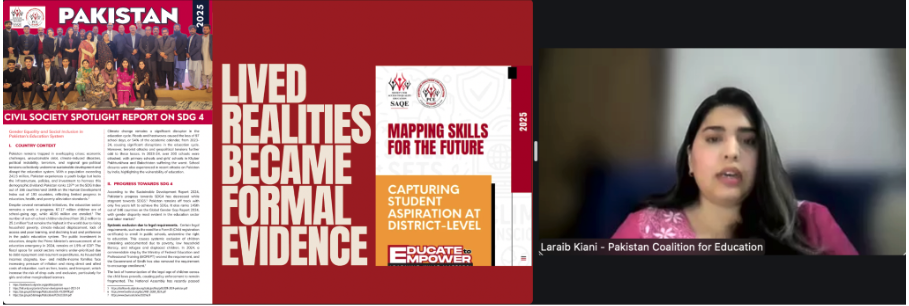
Held on 26 May 2026, this interactive online session gathered youth from across the GCE network and the Kuyenda Collective to “explore how young people are using social accountability to strengthen education systems in practice.” It brought to the fore stories of community-level education monitoring, youth-led evidence generation, advocacy on education financing and equity, policy engagement, and efforts to strengthen accountability in education systems.
Laraib shared examples of PCE’s deliberate efforts to amplify youth voices and meaningfully engage them in social accountability processes, such as structured community conversations through the Harvesting Hope Dialogues, Townhalls where youth meet decision-makers to shift the power, and supporting youth stories, perspectives, and demands through the ASPBAE Civil Society Spotlight Reports on #SDG4.
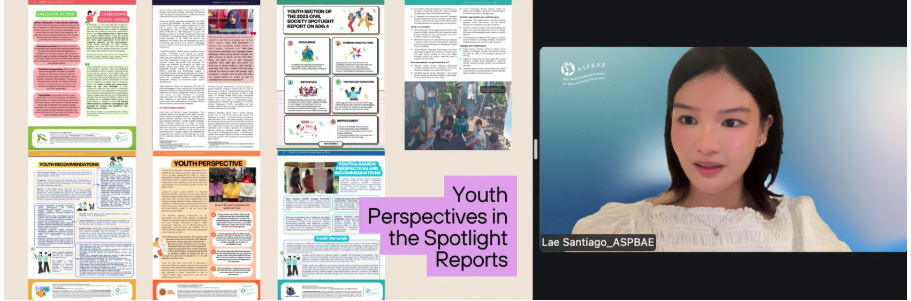
ASPBAE’s Advocacy and Youth Engagement Officer, Lae Santiago, briefly presented the youth perspectives in the Spotlight Reports on SDG 4, which provide more nuanced evidence that uncovers youth’s realities grounded in their lived experiences and put a spotlight on the role and value addition of civil society and young people in advancing the right to education.
We must continue to harness youth voices to turn commitments into actions!
ASPBAE Youth Corner: Youth Exchange on “Transforming Education Outcomes Through Systems Strengthening and Social Accountability Monitoring
Ensuring youth voices in the Asia Pacific region continue to be amplified in accountability spaces at all levels, below is a transcript of the full input provided with permission by Laraib Kiani, Pakistan Coalition for Education (PCE)’s Coordinator of the Program Development, Communications and Advocacy:
1. Think about the time as a young student, you were asked about your perspective on your school, teachers, and the quality of education you were receiving, and someone actually took it seriously and did something with it. For most Pakistani youth in the communities we work with, that moment has never happened. Young people are studied. They are surveyed. They are counted. But their perspective is rarely heard. That’s the gap PCE has been trying to close, not just by giving young people a seat at the table, but by building the table with them.
2. The Problem We Kept Seeing
When we looked at how youth were being included in education accountability work, we kept seeing the same pattern. They either never had a seat at the table, or they were silent observers invited to validate what adults had already decided for them. Youth inclusion felt like a checkbox needed to complete the quorum; youth voice meant a quote in a report. And the result was evidence that didn’t effectively reflect what young people were actually experiencing. Reports that spoke about youth but not for them. Advocacy that lacked the depth of lived reality. We asked ourselves — what would it look like to flip this? To put youth at the start of the accountability chain, not the end?
3. What We Built: Three Entry Points
Youth is Pakistan’s largest demographic with untapped potential. But the best way to channel this potential is by building solutions that reflect their perspectives and respond to their needs. At PCE, we have been making deliberate efforts to amplify youth voices and engage them in the social accountability process. This is not only to channelise their potential but also enables a transformation in their behavior and helps them realise the power they hold.
- Through Harvesting Hope Dialogues, we organize structured community conversations, but they don’t start with a questionnaire or a data collection tool. They start with a question: What does quality education feel like to you? What is missing? Who is responsible?” Young people come in not as respondents but as analysts of their own reality. They name the gaps. They identify who holds power. They decide what accountability should look like. And everything that comes out of those dialogues — is hope, and we harvest it. That’s where the name comes from.
- Townhalls: Youth Voice Meets Power
The second space is our townhalls, where we deliberately bring young people into the same room as decision-makers. District education officers, legislators, school administrations and adults from their own communities. These aren’t complaints sessions. They’re structured accountability moments. Youth are prepared to see their power, their rights through Focus Group Discussions (FGDs) and informal discussions before they come face to face with those who apparently hold more power than them. The shift in the power dynamics is fascinating to observe. The youth come up with their lived experience with questions, with specific asks. And because we’ve invested in their preparation, they show up with confidence, not just grievance. I’ve watched young people in these spaces say things that shifted the conversation in the room. Not because they were polished speakers — but because they were telling the truth about something no one else in that room had lived. And I have observed duty bearers being held accountable and committing to act and address the issues and inequalities.
- The third space is where voice becomes evidence. The insights from dialogues and townhalls don’t stay in the room. We feed them into our research and studies — giving youth-generated data the credibility and reach of formal evidence. We strategically leverage youth voices and experiences in our research, supporting data with lived realities in reports, including the SDG4 Spotlight reports. Our last report took an analytical review of SDG4 with a GESI lens.
4. What This Teaches Us About Systems
Here’s the system’s insight that this work has given us: accountability gaps in education are often not just about bad policy or missing resources. They’re about missing voices — specifically, the voices of the people most affected by how systems fail.
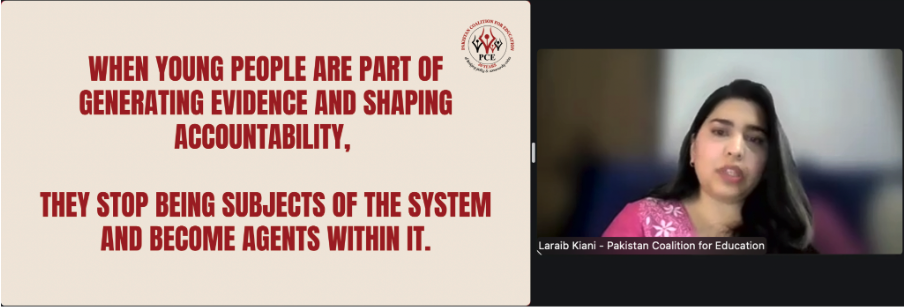
When young people are designed into the accountability process from the beginning — when they’re generating the evidence, naming the gaps, engaging the decision-makers — they stop being subjects of the system and start being agents within it. That shift — from subject to agent — is what systems strengthening actually looks like at the community level.
“So if there’s one thing I want to leave with this room today, it’s this: youth participation in accountability work is not a feel-good add-on. It’s a strategy. It produces better evidence. It builds more durable accountability relationships. And it grows a generation of young people who understand how systems work — and how to change them. At PCE, we’re still learning. But we know that when you invest in giving young people not just a voice but a process — the evidence is richer, the advocacy is sharper, and the system has to pay attention.”