Call for Action: Towards a Rights-Based, Human- and Planet-Centered Youth and Adult Learning and Education (ALE) in Times of Digitalisation and AI

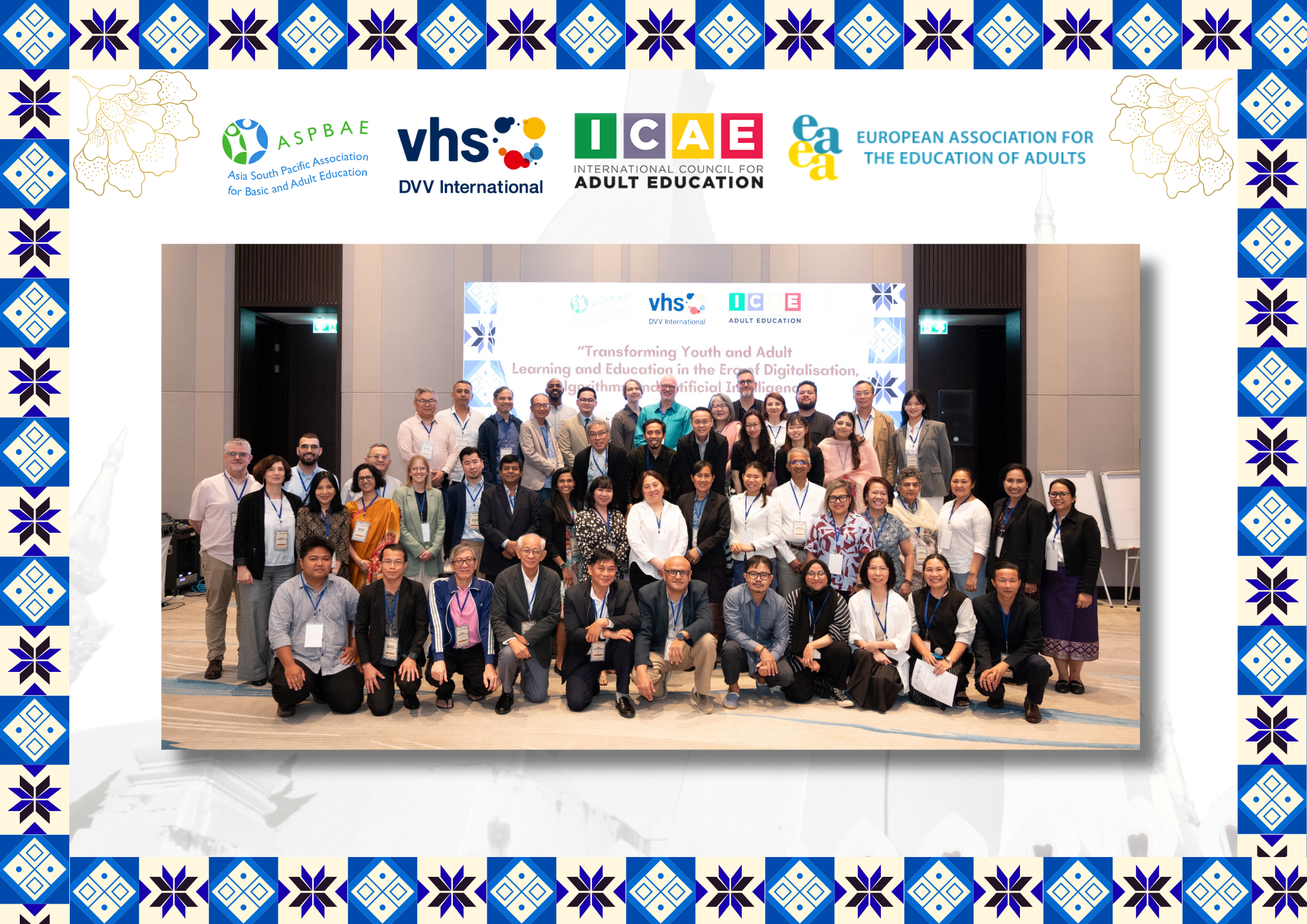
We the partners – Asia South Pacific Association for Basic and Adult Education (ASPBAE), the Institute for International Cooperation of the Deutscher Volkshochschul-Verband e.V. (DVV International) and the International Council for Adult Education (ICAE) – have gathered on 24-26 November 2025 in Vientiane, Laos, for the Think Tank Meeting and Strategising for Education Stakeholders on “Transforming Youth and Adult Learning and Education (ALE) in the Era of Digitalisation, Algorithms and Artificial Intelligence.”
We fully recognise that the rapid acceleration of technologies, including the mainstreaming of artificial intelligence (AI) and algorithmic-driven digital platforms, has significantly transformed the way people work, socialise, filter information and learn. Across sectors and disciplines – from media and journalism, labour and economy, finance, agriculture and healthcare – the latest technological advances have brought seismic changes, necessitating continuous adaptations and critical examinations.
Within the education sector, we have noted that governments and private actors are keen to integrate technology and generative AI in education systems. This is seen to potentially expand education access to remote or underserved regions, offer opportunities for greater attentiveness to diverse needs of learners and, offer greater customised support to students with special needs through assistive functions and communication technologies.
However, this technology integration in education also brings immense challenges amidst wide digital divides, and comes with significant risks – from fostering homogeneity of opinions, undermining the development of creativity, critical thinking and problem-solving skills, increased learners’ exposure to cyber violence and the misuse of their personal data for commercial gains, reinforcing discrimination, the spread of misinformation, political profiling, and social surveillance.
With the growing human dependencies on technology, including the rise of AI, much power and influence lie on Big Tech, the technology giants who have accrued tremendous wealth, power and profound influence on culture, politics and the global economy.
The consequential impact of technology and AI is also contributing to the acceleration and the rise of far-right ideologies, deepening racial and political divides, and ultimately reshaping the global cultural and ideological discourse. All these will further contribute to regressions on a rules-based societal order that is anchored on human rights, peace, freedoms, social and gender justice, equity and inclusion, and climate justice.
As some of the most long-standing civil society formations for the right to education and lifelong learning, ASPBAE, DVV International and ICAE have resolved to undertake advocacy and capacity building efforts to pursue the ethical use of digital technologies and artificial intelligence in ALE, while continuing to put attention to the potentials and risks posed by the fast-evolving digital landscape.
Advocacy efforts at national, regional and global levels in formulating policy, financing and programme designs for technology-supported education systems.
Our advocacy efforts will be focused on:
-
Engaging and influencing decisionmakers on the importance of rights-based, human-centric, inclusive, and ethical policies around digital transformation in youth and ALE at the global, regional, and national levels. Policies and financing in this regard should be based on international human rights law, ecological and climate justice frameworks, and supportive of global commitments to education and development such as the SDGs-SDG4 and the Marrakech Framework for Action on ALE. It will include policy scanning, assessing the readiness of educators and learners through available tools, capturing the intergenerational perspectives on digitalization and AI in education within formal and non-formal systems, and documenting good practices and case studies on education programmes that employ digital technologies.
-
Advocating for the development of good quality, ethical and responsible digital skills for youth and adults, especially marginalised learners, to enhance their social and life skills, empower them to fully exercise their rights, and help bridge the gap in formal labour force participation and promote economic empowerment for all, amidst the wide-ranging implications of technology and AI in various spheres including the world of work.
Mapping Eco-Systems and Leveraging Partnerships
Recognising that the digital landscape cuts across sectors and borders, we will:
-
Undertake cross-sectoral and international mapping exercises of actors, spaces, mechanisms that will drive actions towards rights-based, human-centric, inclusive, and ethical digital transformation in youth and ALE.
-
Work with allies within priority strategic spaces to shape framework conditions for youth and ALE amidst the digital transformation.
Strengthening Internal Capacities to Drive Transformative Actions
Drawing from our depth of experience, wide reach and inherent strengths, we will further deepen these by working closely with our members and partners through:
- Digital literacy and awareness-raising to deepen capacities for critical assessment, ethical and responsible use of AI tools and technologies in education, set within a deeper understanding of the wider economic, political forces that operate in, shape and dictate developments in this sphere. This will especially involve working closely with our members and partners at the grassroots, community and national levels, as well as at the international spaces in defining and sharpening our policy positions on AI and digital technology in education.
- Setting-Up Online, Onsite and Hybrid Learning Platforms which will consist of:
○ Establishing a one-stop-shop for tools, publications and relevant materials on digitalisation linked to youth and ALE.
○ Maintaining a Learning Collaborative on Digitalisation and AI in Education.
○ Facilitating inter-generational peer-to-peer learning and sharing exchanges.
- Hold Annual International Convening on Digitalisation and AI in Education – This will bring in civil society representatives actively working on this issue and with strong focus on education, along with multi-disciplinary experts and partners.
To ensure these collective commitments are translated into concrete actions, a Core Team of representatives from ASPBAE, DVV International, ICAE and the European Association for the Education of Adults (EAEA) will help drive the implementation mechanisms, and further guided by an Intergenerational Advisory Group consisting of Core Team members, experts, allies and youth representatives.
Statement Prepared and Issued by the Organising Partners:
-
Established in 1964, the Asia South Pacific Association for Basic and Adult Education (ASPBAE) is a regional network of 251 civil society organisations and individual members in 31 countries in the Asia Pacific region. It works towards the realisation of the right to education and promoting transformative education and lifelong learning for all. Website: https://www.aspbae.org.
-
DVV International is the Institute for International Cooperation of the Deutscher Volkshochschul-Verband e.V. (DVV), the German Adult Education Association. DVV represents the interests of the approximately 850 adult education centres (Volkshochschulen) and their state associations, the largest further education providers in Germany. DVV International provides worldwide support for the establishment and development of sustainable structures for Youth and Adult Education. Website: https://www.dvv-international.
de/en/. -
The International Council for Adult Education (ICAE) is a global network that champions adult learning and education (ALE) as a human right. Since 1973, ICAE has operated across seven regions, advocating for lifelong learning as a force for social transformation. As a strategic partner with UNESCO and the UN, ICAE uses its global influence to address key challenges like climate change, social justice, and sustainable development. Website: https://icae.global/en/.
-
Established in 1953, the European Association for the Education of Adults (EAEA) is the voice of non-formal adult education in Europe. It links 120 member organisations in 43 countries and represents more than 60 million learners Europe-wide. Through its strategic work, EAEA promotes adult learning and access to and participation in non-formal adult education for all, particularly for under-represented groups in the region. Website: https://eaea.org.
Enclosure: Call for Action on Youth and ALE in Times of Digitalisation and AI_18 December 2025